

Framing Effect
The framing effect changes decisions when the same facts are presented in different ways. A gain frame can feel safer while an equivalent loss frame feels threatening. Wording and context can therefore shift choices without changing the underlying evidence.
When the presentation changes your choice even though the facts stay the same.
See how Framing Effect can shape everyday judgment, then use examples and response prompts to test the assumption before it guides a decision.
How It Shows Up in Everyday Life
The framing effect changes judgment when equivalent information is presented as a gain, loss, success, or failure. The facts remain the same, but the emotional reference point changes what feels safe or attractive. Comparing the underlying numbers can reveal when wording is driving the preference.
Everyday Example: A treatment sounds reassuring when described as having a 90% survival rate and alarming when described as having a 10% mortality rate. The outcomes are identical, but the frame changes your reaction.
How It Looks in Action
Watch the same facts produce different choices when the frame changes.









 ANIMATED LESSON
See the Framing Effect in Action
The same facts can produce different choices when attention is directed toward gains, losses, success, or failure.
 Transcript
00:00–00:08 A decision begins with one set of facts—but those facts can be described in more than one way.
00:08–00:17 A gain frame emphasizes who benefits. A loss frame emphasizes who does not.
00:17–00:27 This is the framing effect: equivalent information can lead to different choices because the presentation changes what feels most important.
00:27–00:38 Positive wording can make an option feel safer, while negative wording can make the same option feel threatening.
00:38–00:49 Better reasoning checks whether the underlying numbers changed—or only the language around them.
00:49–01:00 When the frame shifts, restate the facts in a neutral form and compare both gains and losses before deciding.
 60 sec lesson
REAL-LIFE DEEP DIVE
Framing Effect in Real Life
See how wording changes decisions even when the underlying evidence remains the same.

The Same Migration Result Sounds Safe—or Dangerous
A steering group reacts very differently to “92% successful” and “8% unresolved,” even though both describe the same modernization test.

 What Happened
Setup: A team is reviewing a pilot migration for a legacy platform. The pilot completed 92% of planned workflows, while 8% still require remediation.
- Maya: If we say the pilot was 92% successful, the rollout feels ready.
- Omar: If we say 8% of critical workflows remain unresolved, it feels much riskier.
- Maya: But those are the same facts.
- Architect: Exactly. Let us classify which 8% remain, their impact, and whether the residual risk is acceptable.
- Team lead: We should decide from severity and evidence—not from whichever wording sounds better.
Immediate consequence: The group stops arguing over tone and evaluates the same data neutrally, separating completion rate from the seriousness of the unresolved work.
 How the Frame Steers the Decision
 One resultSame test data
 Gain frameSuccess highlighted
 Loss frameRisk highlighted
 Reaction shiftsChoice changes
 Neutral restatementFacts compared

An Apartment Sounds Affordable—or Overwhelming
A couple hears the same rent described as a monthly saving and as a share of annual income, producing opposite reactions.

What Happened
Setup: Tara and Eli are considering an apartment. The agent compares it with a luxury unit and describes it as a large monthly saving, while their own budget sheet shows the same rent as a heavy annual commitment.
- Agent: This place saves you nine hundred dollars every month compared with the premium unit.
- Tara: That makes it sound like a bargain.
- Eli: But it still consumes almost forty percent of our take-home income.
- Tara: Same rent, completely different feeling.
- Eli: Let us compare total housing cost, savings goals, and alternatives instead of choosing the more flattering frame.
Immediate consequence: They restate the choice in neutral budget terms and avoid letting a favorable comparison hide the real financial burden.
How the Price Story Changes the Feeling
- Same rentOne apartment
- Saving frameCompared with premium option
- Burden frameShare of annual income
- Emotion shiftsRelief vs concern
- Budget normalizedTotal costs reviewed

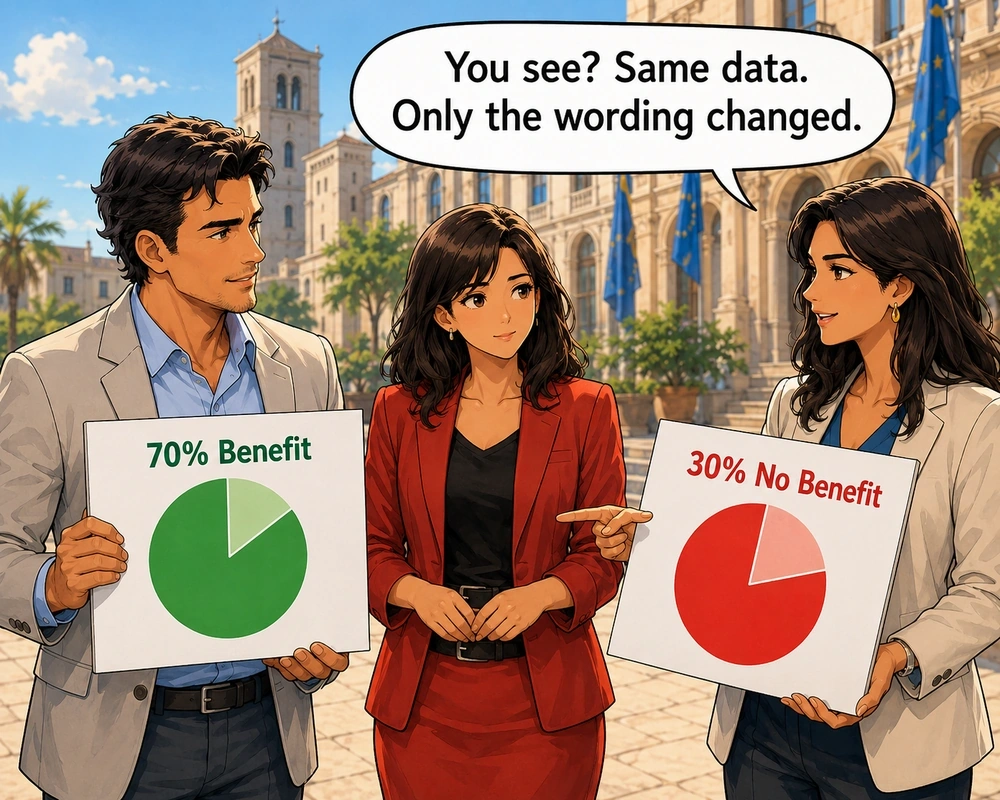
A Community Program Wins or Loses Support Through Wording
A public proposal sounds popular when framed as “70% benefit” and weak when framed as “30% no direct benefit.”

What Happened
Setup: A city is debating a housing-support program. The pilot suggests 70% of eligible households would receive direct benefit, while 30% would not.
- Presenter: Seventy percent of households benefit directly. That sounds like a strong result.
- Panelist: Thirty percent receive no direct benefit. That sounds less convincing.
- Moderator: Those are mathematically identical statements.
- Analyst: We should examine who benefits, who does not, the size of each benefit, and the program cost.
- Moderator: Then the policy can be judged on distribution and evidence rather than a persuasive frame.
Immediate consequence: The debate moves away from competing slogans and toward the full distribution of effects, costs, and alternatives.
How Equivalent Numbers Split the Audience
- One datasetSame households
- Benefit frameMajority foregrounded
- No-benefit frameMinority foregrounded
- Support movesPerception changes
- Full distributionPolicy judged fairly

A Used Car Feels Reliable—or Already Worn Down
“90% battery health” sounds reassuring; “10% capacity loss” sounds alarming, although both describe the same vehicle.

What Happened
Setup: Jules is considering a used electric car. The dealer emphasizes that the battery retains 90% health, while an independent report describes a 10% capacity loss.
- Dealer: The battery still has ninety percent health. That is excellent for its age.
- Jules: That sounds reassuring.
- Friend: The report says it has already lost ten percent of its original capacity.
- Jules: That sounds worse, even though it is the same number.
- Friend: Let us compare range tests, warranty status, and price instead of reacting to the frame.
Immediate consequence: The purchase decision shifts from wording to measurable range, degradation benchmarks, warranty coverage, and total price.
How Equivalent Descriptions Change Value
- One conditionSame battery
- Positive frameHealth emphasized
- Negative frameLoss emphasized
- Value feeling changesConfidence shifts
- Evidence checkedRange and tests used
WHEN WORDING HELPS—AND WHEN IT DISTORTS
Is It Framing Effect or Useful Context?
Presentation is unavoidable. The key question is whether the frame clarifies the evidence or pushes attention toward only one side of it.

Likely Framing Effect
- Equivalent facts trigger different choices because gains or losses are selectively emphasized.
- The emotional wording receives more attention than the underlying numbers.
- One side of the trade-off is foregrounded while the other is hidden.
- A neutral restatement changes the decision substantially.

Potentially Useful Context
- The framing highlights genuinely relevant consequences without hiding equivalent facts.
- Both gains and losses are shown in comparable terms.
- The audience can inspect the underlying numbers and assumptions.
- The frame supports understanding but does not substitute for evaluation.
Question AssumptionsThink More Clearly