

Ad Hominem
An ad hominem attacks a person's character, motives, or circumstances instead of addressing their reasoning. Personal information can feel persuasive even when it has no bearing on whether the claim is true. Sound evaluation separates the argument from the person presenting it.
Attacking the speaker instead of testing the claim.
Learn how Ad Hominem weakens an argument, work through realistic examples, and practice a clearer response focused on the evidence.
How It Shows Up in Everyday Life
An ad hominem shifts attention from a claim to the character, background, motives, or identity of the person presenting it. Personal information can influence how credible an argument feels without addressing whether its evidence is sound. Relevant conflicts of interest should be examined separately from the reasoning itself.
Everyday Example: A junior colleague identifies a safety risk in a proposal. Instead of examining the risk, the team dismisses it by saying that someone with so little experience should not question senior staff.
How It Looks in Action
See a personal attack distract from the argument that still needs an answer.









 ANIMATED LESSON
See Ad Hominem in Action
A 60-second lesson shows how a personal attack can redirect a high-stakes review away from evidence that still needs an answer.
 Transcript
00:00–00:08 Leila has found a recurring fault and recommends pausing the launch until the team checks it. The schedule is tight, and senior leaders expect approval today.
00:08–00:16 Marcus: “You have been here six months. You do not understand how launches really work.” He does not mention the repeatable fault.
00:16–00:25 Narrator: “The reply changes the subject—from the test result to the person who reported it. The claim is still waiting for an answer.”
00:25–00:34 Marcus: “This sounds more like proving yourself than protecting the product.” The remark makes the room look at her ambition, not the failing component.
00:34–00:43 Priya: “Which result is wrong? Her experience and her motive are separate questions.”
00:43–00:52 Narrator: “Relevant expertise can be examined, but it cannot replace testing the claim itself.”
00:52–01:00 Narrator: “Keep the person and the argument separate. Ask what evidence the personal criticism is meant to refute.”
 60 sec lesson
REAL-LIFE DEEP DIVE
Ad Hominem in Real Life
See how personal attacks displace the real question—and how to restore a fair evaluation of the claim.

Experience Is Used to Dismiss Safety Data
A junior analyst identifies a repeatable product fault, but the review shifts to her tenure and motives instead of the test results.

 What Happened
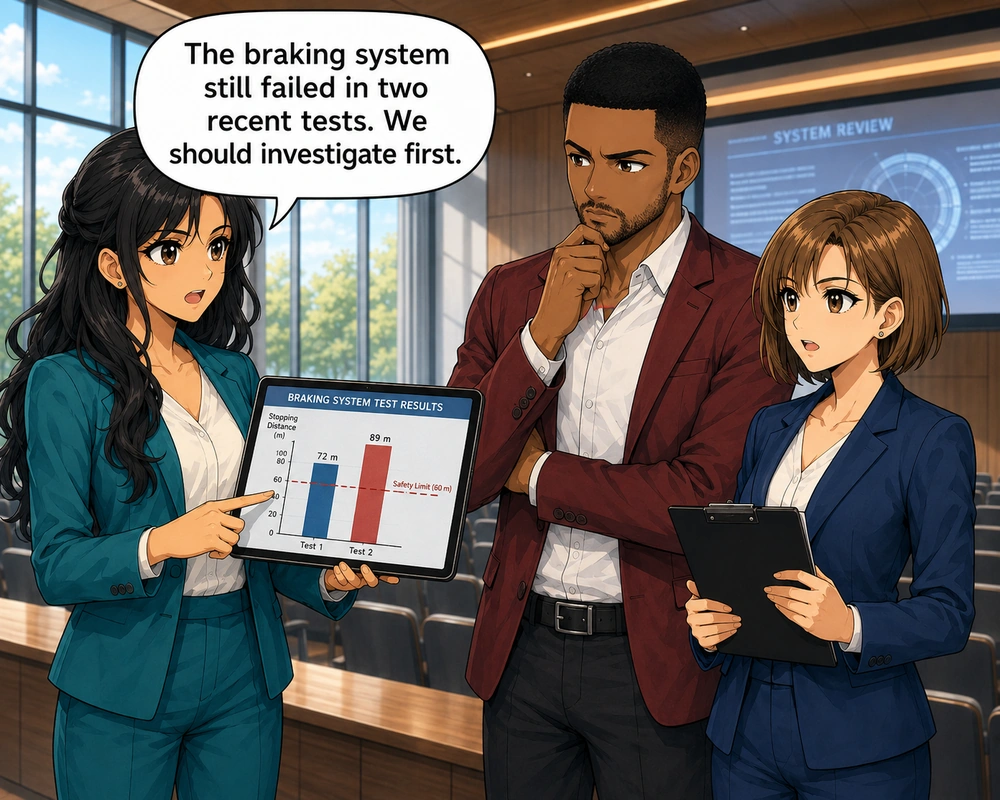
Setup: Leila is a junior reliability analyst on a product launch team. After three test runs show the same braking fault, she asks the review group to delay release for forty-eight hours.
- Leila: The failure appeared in three separate runs. I recommend pausing the launch while we inspect the component.
- Marcus: You have only been on this team six months. You do not understand the pressure behind a launch.
- Leila: That may be true, but which test result do you think is unreliable?
- Marcus: New analysts often overstate problems because they want to prove they belong in the room.
- Priya: Her motive is not the safety question. Let us check the runs and the sampling method.
- Marcus: Fine. We can review the data before deciding whether the schedule changes.
Immediate consequence: The launch is nearly approved without examining a repeatable fault because Leila’s experience is treated as an answer to her evidence. Priya restores the actual decision.
 The Distraction Path
 Safety evidenceRepeatable fault
 Attack tenure“Too new”
 Lower credibilityPerson judged
 Data sidelinedClaim untested
 Risk remainsLaunch proceeds

A Specific Concern Becomes “Too Sensitive”
A partner raises one concrete behavior, but the response labels her personality and avoids discussing what happened.

What Happened
Setup: Leila and Marcus agreed that either person would send a message before inviting coworkers to stay late after dinner. Marcus changes the plan without telling her, and Leila raises it the next evening.
Leila explains that the surprise made her feel excluded from a decision affecting their shared home. Marcus does not ask what part of the agreement felt broken. He says she has always been overly sensitive and turns small changes into major problems. Leila starts defending her personality instead of discussing the missed message. When she returns to the concrete event—one agreement, one unannounced change—Marcus recognizes that calling her sensitive has not answered whether he followed what they decided together.
Immediate consequence: The label nearly converts a solvable communication problem into a judgment about Leila’s character. Returning to the agreed behavior creates a clear issue they can repair.
How the Concern Gets Reframed
- Specific behaviorMissed agreement
- Personality label“Too sensitive”
- Focus shiftsHer character
- Repair avoidedNo answer
- Resentment growsIssue repeats

The Speaker’s Affiliation Replaces the Policy
A transport proposal is dismissed by attacking the advocate’s background, while its safeguards and evidence receive no evaluation.

What Happened
Setup: At a civic transport forum, Leila supports a six-month redesign trial at two dangerous junctions. The proposal includes independent collision reporting, a spending cap, and a public review date.
- Leila: The trial is limited to two junctions, and renewal depends on the published collision data.
- Opponent: Of course you support it. You worked for a mobility company, so you are just another corporate insider.
- Leila: My employment is public. Which safeguard or cost estimate do you dispute?
- Opponent: People with your background always find a technical excuse for expanding control.
- Moderator: Please address the proposal. A conflict of interest matters only if you show how it affects this evidence.
- Opponent: Then I should explain why I think the reporting process is not independent enough.
Immediate consequence: The forum nearly judges Leila’s identity instead of the trial’s design. The moderator separates a potentially relevant disclosure from an unsupported attack on the speaker.
The Substituted Question
- Policy proposedSafer junctions
- Affiliation attacked“Corporate insider”
- Identity judgedAudience cue
- Safeguards ignoredNo evaluation
- Vote distortedWrong basis

A Product Defect Becomes “Constant Complaining”
A documented fault is brushed aside by labelling the customer difficult instead of checking the warranty evidence.

What Happened
Setup: Priya accompanies Leila to return a water filter that cracked after two weeks. Leila brings the receipt, photographs of the leak, and the warranty terms saved on her phone.
The service manager remembers that Leila previously returned a different appliance and says she seems to complain about every product she buys. He begins to reject the claim without opening the photographs or checking the model number. Priya asks whether the earlier return changes the current warranty and whether the crack matches the listed defect. Once the manager examines the evidence, he finds that the batch is already under review. The customer’s history may justify checking records carefully, but it does not establish that this claim is false.
Immediate consequence: A personal label almost replaces the warranty decision. Separating Leila’s reputation from the documented defect leads to a proportionate review and a valid replacement.
How the Service Question Disappears
- Defect documentedReceipt and photos
- Customer labelled“Always complains”
- Record discountedPerson judged
- Warranty avoidedTerms unchecked
- Bad decisionClaim denied
WHEN CONTEXT IS—AND ISN’T—RELEVANT
Is It Ad Hominem or Relevant Context?
Personal information matters only when a clear connection shows how it affects the claim, evidence, or source reliability.

Likely an Ad Hominem Fallacy
- Character or motives replace an answer to the claim.
- The criticism would not show the evidence is false.
- Labels are used to lower credibility without support.
- The same reasoning escapes direct evaluation.

Potentially Relevant Credibility Context
- A disclosed conflict directly affects the evidence presented.
- Specific expertise is necessary to interpret the method.
- A reliability problem is documented and claim-relevant.
- The argument still receives an independent evaluation.
Spot Weak ArgumentsReason Clearly