

Appeal to Emotion
An appeal to emotion uses fear, pity, anger, guilt, or enthusiasm as a substitute for relevant evidence. Emotions can matter to a decision, but their intensity does not prove a factual claim. Careful reasoning identifies the feeling and then examines the argument independently.
Using emotional pressure as a substitute for relevant evidence.
Learn how Appeal to Emotion weakens an argument, work through realistic examples, and practice a clearer response focused on the evidence.
How It Shows Up in Everyday Life
An appeal to emotion uses fear, pity, guilt, anger, pride, or enthusiasm as the main support for a conclusion. Emotions may be relevant to a decision, but their intensity does not establish a factual claim or replace a missing logical connection. Removing the emotional language reveals what evidence remains.
Everyday Example: A student argues that they deserve a higher grade because they had an extremely difficult semester and would be devastated by the result. Their circumstances deserve empathy, but they do not by themselves demonstrate that the submitted work met the grading criteria.
How It Looks in Action
Watch a safety decision unravel when emotion replaces evidence.








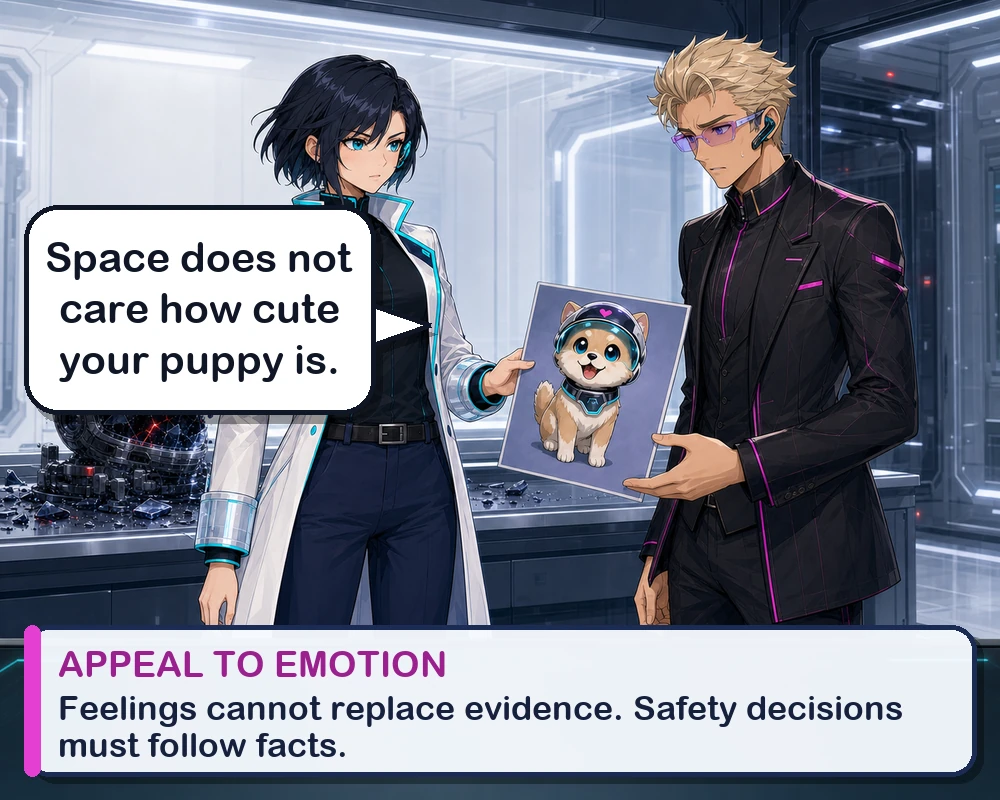

 ANIMATED LESSON
See Appeal to Emotion in Action
A 60-second lesson shows how fear, pity, hope, and guilt can sound persuasive—while still failing to answer the evidence question.
 Transcript
00:00–00:08 A product team is reviewing a new space visor after a pressure test reveals a dangerous crack.
00:08–00:16 Rin, the materials lead, says production must stop until the visor material is replaced.
00:16–00:25 Leon, the brand director, plays a touching campaign about protecting families and says cancelling would destroy hope.
00:25–00:34 Narrator: “The feeling is real—but it does not answer whether the visor is safe.”
00:34–00:43 A teammate asks to return to the test data instead of the emotional video.
00:43–00:52 The failed pressure results stay the same, no matter how inspiring the ad sounds.
00:52–01:00 Narrator: “Appeal to emotion happens when feelings are used as proof. Respect the feeling—then return to evidence.”
 60 sec lesson
REAL-LIFE DEEP DIVE
Appeal to Emotion in Real Life
See how fear, pity, guilt, and hope can push decisions away from the facts—and how to bring the argument back to evidence.

A Safety Decision Is Replaced by a Heartwarming Campaign
A product team nearly ignores a failed test because an executive frames delay as a betrayal of families and hope.

 What Happened
Setup: Aurora Orbital is reviewing whether its new child-sized astronaut visor should move into production after a safety test.
- Rin: The visor cracked under pressure. We have to stop production and replace the shell material.
- Leon: Stop production? This campaign gives families hope. Do you really want to crush that?
- Mira: The campaign is touching, but does it change the test result?
- Leon: People believe in what we are building. We cannot abandon them because of one discouraging moment.
- Rin: Hope matters. But it is not evidence that the visor is safe.
- Team lead: We keep the empathy—and we still halt the launch. Safety must follow the data.
Immediate consequence: The team nearly confuses inspiration with proof. Once they refocus on the failed test, the emotional appeal loses its force as an argument.
 How Emotion Replaces the Evidence
 Safety problem foundPressure test fails
 Emotional story introducedFamilies and hope
 Feeling treated as proofData loses priority
 Risk remains unchangedProduct still unsafe
 Reasoning restoredDecision returns to evidence

A Family Is Pressured by Hope Instead of Medical Evidence
A persuasive pitch for a memory device leans on love and guilt, even though the independent evidence is weak.

What Happened
Setup: Noah and Mara are considering an expensive “memory reconnection” device for their father after watching an emotional product presentation.
- Sales rep: This is not about numbers. It is about giving your father his precious memories back while you still can.
- Mara: I want that too. But what clinical evidence shows this device works?
- Sales rep: A loving family does not put a price on hope.
- Noah: Hope is important, but guilt is not proof. The independent review says the benefits are unproven.
- Father: I do not want you spending your savings on promises alone.
- Mara: Then we wait for better evidence before we decide.
Immediate consequence: The emotional appeal almost turns caution into disloyalty. By separating compassion from proof, the family makes a more careful decision.
How Hope and Guilt Cloud the Choice
- Painful problem existsFamily wants help
- Hopeful message amplifiedLove and precious moments
- Question becomes moral“Do you care enough?”
- Evidence is sidelinedBenefits unproven
- Decision improvesFamily asks for data first

A Surveillance Proposal Rides on Fear and Grief
At a public hearing, a proposal gains momentum through emotional imagery and tragic stories rather than evidence of effectiveness.

What Happened
Setup: A city council is debating a new emergency surveillance network after a tragic local incident.
- Council speaker: If you reject this plan, tell the families why you were willing to gamble with their children’s safety.
- Analyst Rin: The issue matters deeply. But what evidence shows this network will reduce attacks?
- Council speaker: Must we really hide behind spreadsheets when people are grieving?
- Citizen: The grief explains why we care. It does not prove this proposal will work.
- Chair: Then we need data on effectiveness, cost, and oversight before the vote.
Immediate consequence: The room feels the emotional pressure to act immediately. A better response distinguishes urgency from proof and demands evidence before expanding power.
How Fear Pushes Policy Faster Than Proof
- Public concern risesSafety is urgent
- Emotionally intense case shownFear and grief
- Opposition is moralized“How can you say no?”
- Evidence gap remainsEffectiveness unclear
- Policy is slowed downPilot and review required

A Fear-Based Pitch Tries to Sell Security as Proof
A salesperson leans on alarming imagery and parental fear to make an expensive gadget seem necessary.

What Happened
Setup: Aya and Leo are comparing wearable safety devices in a tech store when the salesperson steers the conversation toward fear.
- Salesperson: Imagine your child alone at night. Could you forgive yourself if you walked out without the Guardian Pro?
- Aya: That is a frightening picture, but what tests show it works better than the standard model?
- Salesperson: People who care do not compare spec sheets when safety is on the line.
- Leo: Concern is exactly why we should compare them. Fear does not prove this one is better.
- Aya: Let us read the independent reviews before we buy anything.
Immediate consequence: The ad makes the premium device feel mandatory. Once the shoppers ask for evidence, the emotional pressure stops doing the work of proof.
How Fear Sells More Than the Product Shows
- Purchase under considerationNeed unclear
- Fear trigger addedDangerous scenario shown
- Anxiety becomes argument“Can you risk it?”
- Product evidence skippedComparisons avoided
- Choice improvesIndependent reviews checked
SPOT THE DIFFERENCE
When Emotion Informs vs. When Emotion Replaces
Not every emotional statement is fallacious. The key question is whether the feeling adds context—or substitutes for evidence.

Likely an Appeal to Emotion
- The speaker uses fear, pity, anger, guilt, or hope as if the feeling itself proves the conclusion.
- Emotional intensity replaces the request for data, reasons, or direct evidence.
- Disagreement is framed as cold, uncaring, or immoral instead of being answered on the merits.
- The argument becomes persuasive because it feels urgent—not because it has been shown to be true.

Emotion Can Matter Without Becoming Proof
- Feelings can explain why an issue matters and why people care about the outcome.
- Emotional context is legitimate when it accompanies evidence instead of replacing it.
- Compassion and urgency still require facts about effectiveness, risk, and alternatives.
- A sound decision acknowledges the feeling, then evaluates the claim on independent grounds.
Spot Weak ArgumentsReason Clearly