

Appeal to Authority
An appeal to authority treats a person's status or expertise as decisive proof of a claim. Expert judgment can be valuable, but it must be relevant, accurately represented, and supported by evidence. Authority cannot replace the reasoning needed to establish the conclusion.
Treating status or expertise as proof instead of examining the evidence.
Learn how Appeal to Authority weakens an argument, work through realistic examples, and practice a clearer response focused on the evidence.
How It Shows Up in Everyday Life
An appeal to authority treats a respected name, title, or institution as sufficient proof instead of examining the supporting evidence. Expertise can be highly relevant, but only when it matches the subject and the opinion is represented accurately. Status cannot make an unsupported conclusion true.
Everyday Example: A famous actor recommends a nutritional supplement, and the advertisement presents their confidence as the main reason to believe its medical claims. Their popularity does not establish relevant expertise or evidence.
How It Looks in Action
Watch status replace proof while the claim itself goes untested.








 ANIMATED LESSON
See Appeal to Authority in Action
A 60-second lesson shows how prestige and expert status can sound persuasive—yet still fail to prove that a recommendation fits the case at hand.
 Transcript
00:00–00:08 A product team is deciding which rollout strategy fits a difficult client launch.
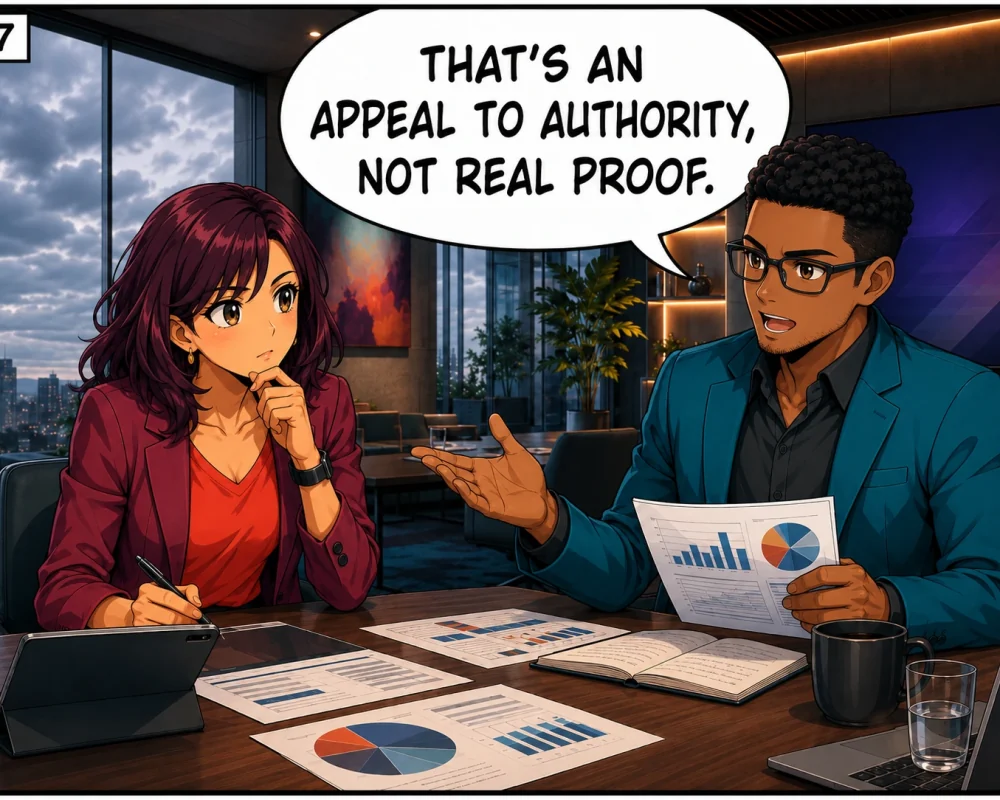
00:08–00:16 Maya says the famous consultant Dr. Vale recommends one framework, so that must be the winning approach.
00:16–00:25 Narrator: “Expert judgment can be useful, but status alone does not prove the claim.”
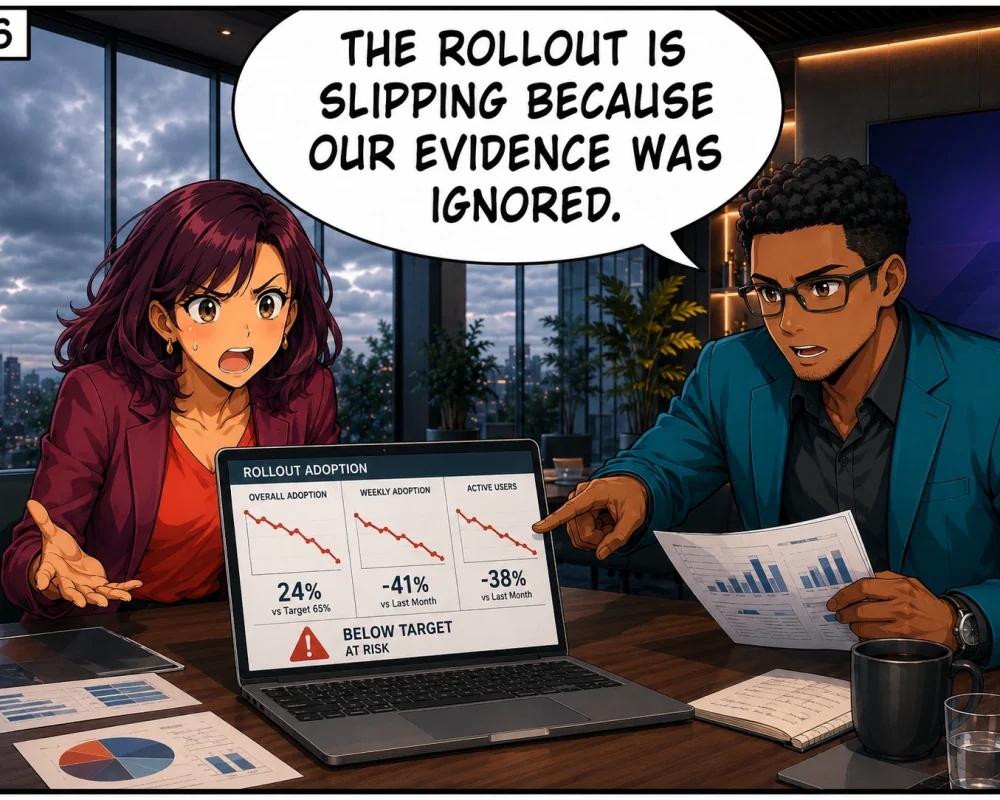
00:25–00:34 Omar points to the team’s own test results, showing their clients respond differently from the cases Dr. Vale usually studies.
00:34–00:43 The room shifts from prestige to evidence: What assumptions does the expert make, and do they fit this situation?
00:43–00:52 Narrator: “A real evaluation asks whether the authority is relevant, accurately represented, and supported by independent reasons.”
00:52–01:00 Narrator: “Use authority as input—not as proof. The claim still needs evidence of its own.”
 60 sec lesson
REAL-LIFE DEEP DIVE
Appeal to Authority in Real Life
See how status, titles, and endorsements can crowd out direct reasoning—and how to bring the evidence back to center.

A Famous Consultant Is Treated as Final Proof
A team nearly adopts a rollout strategy just because a celebrated expert endorsed it, even though their own data points elsewhere.

 What Happened
Setup: Maya and Omar are preparing a rollout strategy for a large client account. Maya has found a framework promoted by the well-known consultant Dr. Vale.
- Maya: Dr. Vale built this framework, and his methods dominate the industry. We should use it.
- Omar: His reputation matters, but our pilot results point to a different adoption pattern.
- Maya: He is the top expert in the field. If he says it works, that should settle it.
- Omar: Only if his assumptions match our clients. Let us test his model against our own data.
- Team lead: Good. We can use his framework as a reference, but not as proof that it fits this launch.
Immediate consequence: The team almost mistakes prestige for evidence. Once they compare the expert’s advice with their own pilot results, they see that authority alone cannot decide the strategy.
 How the Authority Replaces the Test
 Decision neededChoose rollout plan
 Expert citedPrestige emphasized
 Status treated as proofReasoning skipped
 Local data sidelinedMismatch ignored
 Evaluation restoredEvidence reviewed

A Famous Advisor’s Rule Overrides the Couple’s Reality
A household decision is pushed through by citing a respected advisor, even though the couple’s own budget and timing need separate evaluation.

What Happened
Setup: Maya and Omar are deciding whether to combine their savings into one aggressive investment plan before moving in together. Maya has been following a famous financial advisor online.
During an evening planning session, Maya points to the advisor’s profile and says his reputation proves that the higher-risk plan is the right move. Omar does not deny that the advisor is accomplished, but he points to their budget sheets, timeline, and emergency-fund needs. The real question is not whether the advisor is impressive. It is whether his recommendation fits their income volatility, near-term rent commitments, and risk tolerance. Once they compare the recommendation with their own numbers, they realize the authority cannot substitute for personal fit.
Immediate consequence: The famous name makes one option sound unquestionable, but the couple still needs to examine whether the advice matches their situation. Authority offers guidance, not automatic proof.
How the Advice Becomes “Automatically Right”
- Shared choiceBudget planning
- Advisor quotedStatus invoked
- Case details fadeContext ignored
- Pressure increasesDisagreement sounds irrational
- Reality checkedOwn numbers reviewed

A Policy Is Sold Through Endorsement Instead of Argument
At a public hearing, a proposal gains force from a decorated authority figure’s backing, while the local evidence still needs scrutiny.

What Happened
Setup: A city forum is evaluating a new public-service framework. Maya highlights an endorsement from a nationally celebrated policy expert, while Omar presents local performance data that raises doubts about the fit.
- Maya: Professor Vale designed this framework and has advised national agencies. That is why we should adopt it.
- Omar: His credentials are real, but our own service patterns differ from the regions he studied.
- Moderator: Please address the evidence directly. What makes the framework work here, not just in general?
- Maya: His success record shows that the model deserves serious trust.
- Moderator: Then let us test whether that trust is supported by local numbers, costs, and outcomes.
Immediate consequence: The endorsement almost becomes the main argument. The moderator restores the real standard: even strong authority must still be connected to the case with evidence and reasoning.
How Endorsement Distorts the Debate
- Policy choicePublic decision
- Authority displayedCredentials highlighted
- Audience swayedPrestige substitutes
- Local fit untestedEvidence still open
- Debate correctedReasons examined

A Premium Purchase Is Justified by a Star Reviewer
A buying decision starts to revolve around influencer status and star ratings instead of the shoppers’ actual needs and constraints.

What Happened
Setup: Maya and Omar are shopping for a new laptop and accessories. Maya is excited because a famous tech reviewer has given one premium model a glowing endorsement.
At the showroom counter, the reviewer’s image and star rating dominate the conversation. Maya treats the endorsement as decisive proof that the premium bundle is the right choice. Omar responds by comparing battery life, software needs, repair options, and budget on a checklist. The salesperson helps separate the review from the buyers’ actual requirements. A respected reviewer may offer useful information, but that still does not prove the product is best for every customer.
Immediate consequence: The appeal to authority makes the recommendation feel settled before the shoppers evaluate their own priorities. Once they compare the options directly, they can choose on reasons rather than prestige.
How the Review Becomes “Proof”
- Need identifiedChoose device
- Celebrity review shownAuthority appealed to
- Features assumed bestNeeds underchecked
- Comparison reopenedCriteria clarified
- Better fit chosenReasoned decision
WHEN EXPERTISE HELPS—AND WHEN IT DOESN’T FINISH THE JOB
Is It an Appeal to Authority or Legitimate Expertise?
Authorities can provide valuable evidence, but their status is not enough by itself. The key question is whether the expertise is relevant, accurately represented, and still supported by reasons.

Likely an Appeal to Authority
- The speaker treats a title, reputation, or endorsement as if it proves the conclusion by itself.
- The authority’s relevance to this exact case is unclear or exaggerated.
- Independent evidence is skipped because the source sounds impressive.
- Disagreement is framed as irrational simply because an expert said otherwise.

Potentially Legitimate Expert Input
- The expert’s field is directly relevant to the claim being made.
- Their view is represented accurately rather than vaguely or selectively.
- The recommendation is backed by methods, evidence, or reasons that can be examined.
- Authority supports the argument, but does not replace independent evaluation.
Spot Weak ArgumentsReason Clearly