

Circular Reasoning
Circular reasoning uses the conclusion itself as support for that same conclusion. The premises may be reworded, but they provide no independent reason to accept the claim. Breaking the circle requires evidence that remains valid without assuming the conclusion.
Repeating the conclusion as its own proof.
Learn how Circular Reasoning weakens an argument, work through realistic examples, and practice a clearer response focused on the evidence.
How It Shows Up in Everyday Life
Circular reasoning repeats the conclusion as one of its own supporting reasons, often using different words. The explanation feels complete because it moves through several statements, but no independent evidence enters the loop. Someone who doubts the original claim is given nothing new to evaluate.
Everyday Example: A workplace policy is described as the best approach because it is the official policy. When asked why it is official, the answer is that the organization only makes the best approaches official.
How It Looks in Action
See a conclusion disguise itself as its own supporting evidence.








 ANIMATED LESSON
See Circular Reasoning in Action
A 60-second lesson shows how a claim can sound defended while merely repeating itself in different words—and how to break the loop by asking for independent evidence.
 Transcript
00:00–00:08 A team is deciding whether to approve the Aurora plan for a major client rollout.
00:08–00:16 One manager says the plan should be approved because it is the most effective option.
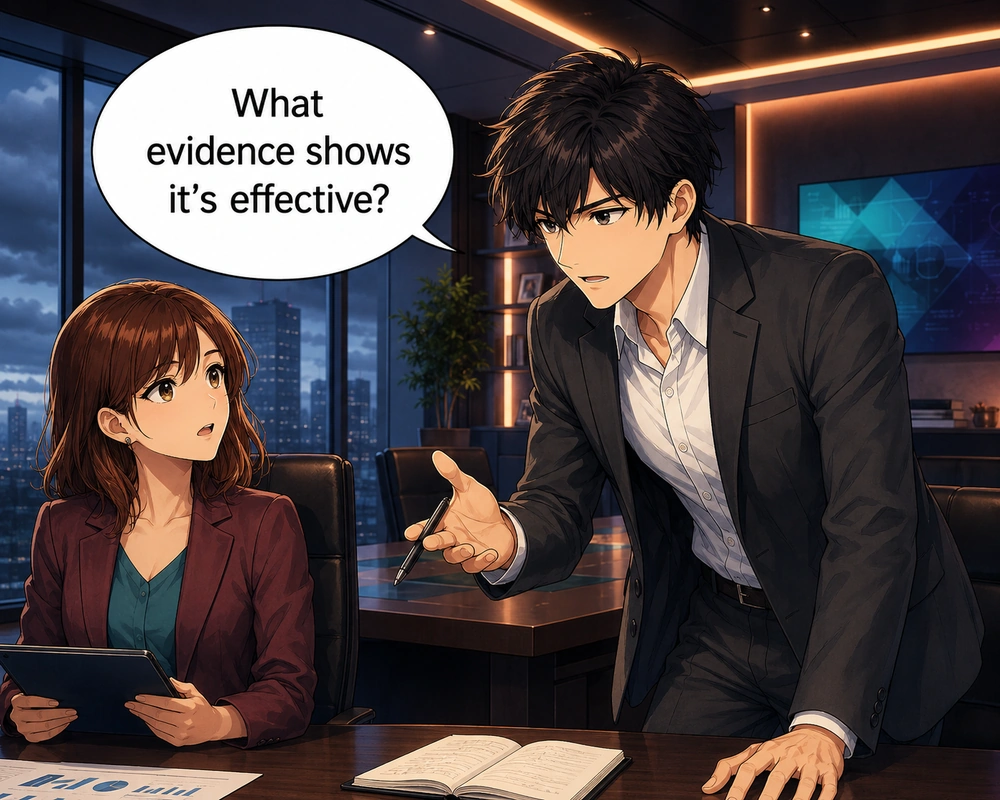
00:16–00:24 When asked what evidence shows it is effective, the answer comes back: because it is the plan that works best.
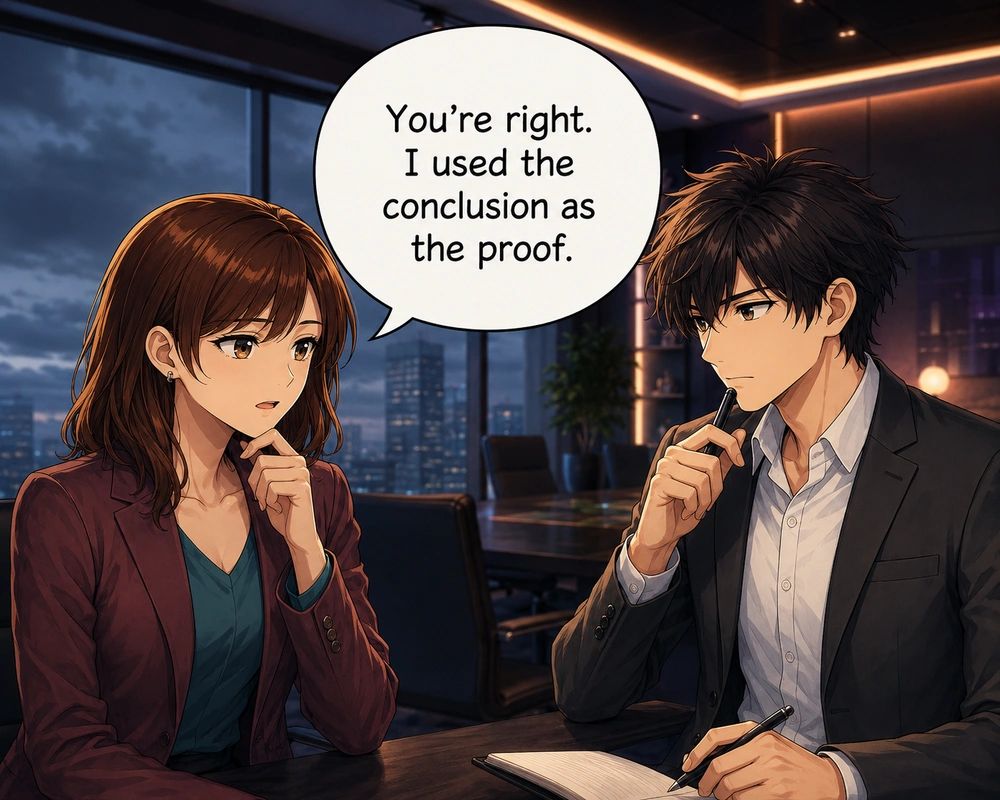
00:24–00:34 Narrator: “That sounds like support, but it only restates the conclusion instead of giving an independent reason.”
00:34–00:43 The team pauses and compares pilot data, client feedback, and risk metrics instead of rephrasing the same claim.
00:43–00:52 Narrator: “Circular reasoning uses the claim itself as its own support. Rewording the conclusion does not count as evidence.”
00:52–01:00 Narrator: “To break the circle, ask what would still support the claim even if the conclusion were not assumed.”
 60 sec lesson
REAL-LIFE DEEP DIVE
Circular Reasoning in Real Life
See how people can sound convincing while quietly using the conclusion as its own proof—and how to restore real support.

A Team Defends a Proposal by Repeating the Claim
A product decision stalls when “the Aurora plan works because it is the best plan” is offered as if it were evidence.

 What Happened
Setup: In a strategy meeting, Lina recommends approving the Aurora rollout plan. Kai asks what evidence shows it should be the final choice.
- Lina: We should approve the Aurora plan because it is the most effective plan.
- Kai: What evidence shows it is effective for this client?
- Lina: Because it is the plan that will work best.
- Kai: That restates the conclusion. What pilot data, test results, or customer signals support it?
- Project lead: Let us compare the actual reports on the table instead of repeating the claim in new wording.
Immediate consequence: The discussion sounds confident at first, but the “reason” is only the conclusion repeated. Once the team looks for independent evidence, the loop is exposed.
 How the Reasoning Loops Back on Itself
 Claim madeApprove the plan
 Why askedNeed real support
 Conclusion repeatedReworded, not proven
 Evidence missingNo independent basis
 Loop brokenData compared directly

A Home Planning Dispute Keeps Going in Circles
An evening conversation about schedules and responsibilities gets stuck when one partner keeps defending a plan by saying it is the plan that works best.

What Happened
Setup: Lina and Kai are planning a demanding month of work deadlines, errands, and shared responsibilities. They need a realistic weekly schedule.
Lina points to the planner and says her proposed routine is the best arrangement because it is the schedule that will work most smoothly. Kai asks what makes it workable: commuting times, who is home on which evenings, and which tasks are fixed. Instead of naming those constraints, Lina keeps circling back to the same idea in slightly different words. The conversation only becomes productive once both of them list the concrete limits and compare the plan against those facts.
Immediate consequence: The disagreement feels like a dead end because the “support” never leaves the original claim. Independent reasons—time, availability, and responsibilities—are what finally move the discussion forward.
How the Discussion Gets Stuck
- Decision neededShared schedule
- Plan defendedClaim sounds settled
- Why questionedNeed concrete reasons
- Same idea repeatedOnly rephrased
- Clarity restoredSpecific constraints reviewed

A Public Hearing Mistakes Repetition for Proof
At a civic hearing, a spokesperson defends a policy by restating that it is the strongest option, while a moderator asks for evidence beyond the claim itself.

What Happened
Setup: During a community hearing, Lina argues that a new public initiative deserves approval. Kai questions how the initiative has been shown to work.
- Lina: This initiative should pass because it is the strongest and most effective program before us.
- Kai: What evidence demonstrates that effectiveness in our city?
- Lina: Because it is obviously the program that will work best.
- Moderator: That repeats the conclusion. Please point to the data, outcomes, or comparisons that support the claim.
- Kai: Without evidence beyond the assertion itself, the audience has only heard the claim twice.
Immediate consequence: The public setting makes the repeated claim sound more forceful than it is. The moderator breaks the circle by requiring support that does not assume the conclusion.
How the Audience Can Be Misled
- Policy claimProposal endorsed
- Support requestedNeed outside reasons
- Conclusion recycledStill the same claim
- Authority pauses debateModerator intervenes
- Standards resetEvidence must be shown

A Shopping Recommendation Uses the Product Claim as Its Own Proof
At an electronics showroom, a recommendation sounds persuasive until the buyers realize the support is only the conclusion repeated in sales language.

What Happened
Setup: Lina and Kai are shopping for a new phone and asking which model best fits their needs for battery life, camera quality, and price.
The store associate recommends one premium model and implies the choice is obvious. When Kai asks why it is the right pick, the explanation comes back as a variation of the same claim: it is the best option because it is the top choice and the most reliable one. Lina and Kai then shift the conversation to measurable differences on the comparison sheet—battery life, repairability, software support, and price. Once the recommendation is tested against those criteria, the circular pitch loses its force.
Immediate consequence: The sales message sounds informative until the buyers notice that it never leaves the conclusion. Real support requires features and evidence, not a polished repetition of the claim.
How the Sales Pitch Loops
- Product suggestedOne model recommended
- Buyer asks whyNeeds useful reasons
- Claim recycledBest because best
- Comparison demandedFeatures and fit
- Decision improvedEvidence-based choice
WHEN A REASON IS REALLY JUST THE CLAIM AGAIN
Is It Circular Reasoning or a Real Supporting Reason?
A real argument gives support that could stand even if the conclusion were in doubt. Circular reasoning only rephrases the conclusion and treats that repetition as proof.

Likely Circular Reasoning
- The “reason” simply repeats the conclusion in similar words.
- No independent evidence, example, test, or principle is added.
- The argument sounds complete only because the wording changes, not because new support appears.
- If you remove the conclusion, nothing substantial remains to support it.

Potentially Genuine Support
- The argument provides evidence that does not assume the claim is already true.
- Specific facts, outcomes, comparisons, or principles explain why the conclusion follows.
- The support could still be evaluated even by someone who doubts the conclusion.
- Key terms are clarified instead of being restated as if they were proof.
Spot Weak ArgumentsReason Clearly