

Slippery Slope
A slippery slope claims that one step will trigger an escalating chain of severe consequences. The intermediate links are treated as inevitable without sufficient evidence. A stronger argument evaluates the probability and mechanism of every claimed step.
Treating an unsupported chain of escalating consequences as inevitable.
Learn how Slippery Slope weakens an argument, work through realistic examples, and practice a clearer response focused on the evidence.
How It Shows Up in Everyday Life
A slippery slope turns one proposed step into an inevitable chain of increasingly severe consequences. The intermediate links receive little evidence, and safeguards or stopping points are ignored. A possible risk becomes a fallacy when probability and mechanism are replaced by certainty.
Everyday Example: Someone argues that allowing one remote-work day will soon mean nobody comes to the office, collaboration disappears, and the company eventually fails. None of the transitions in that chain is examined.
How It Looks in Action
See one small step become an inevitable catastrophe without evidence.









 Animated lesson
See Slippery Slope in Action
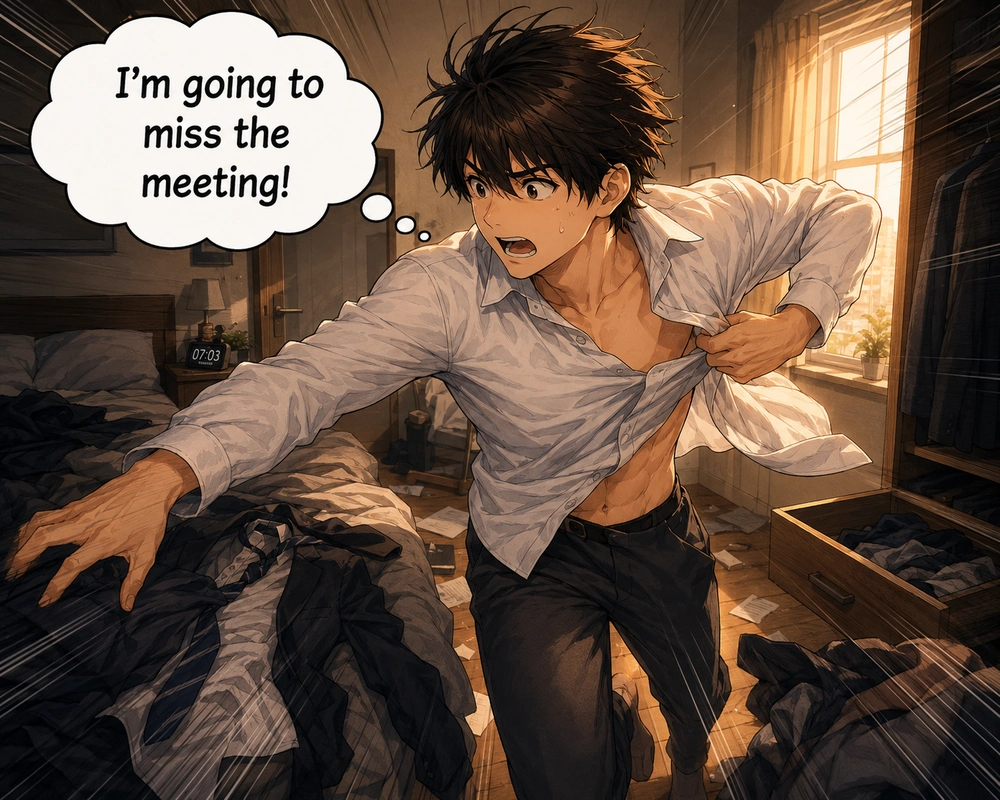
A 38-second animated lesson shows how one missed meeting becomes an unsupported chain of imagined disasters—and how to interrupt it.
 Transcript
0:00–0:05 — The small choice. “Just five more minutes. That won’t hurt.”
0:06–0:10 — The mistake. He wakes late: “What? Eight-thirty? The meeting!”
0:11–0:17 — The actual consequence. His manager says, “The client already left. We’ll contact them and reschedule.”
0:18–0:28 — The imagined chain. “We’ll lose the client. Then I’ll be fired. Then I’ll lose everything.”
0:29–0:34 — The correction. “Wait. One missed meeting doesn’t prove any of that.”
0:35–0:38 — The lesson. “Assuming an unsupported chain of disasters—that’s the slippery slope.”
 Real-life deep dive
Slippery Slope in Real Life
See how a small step can be turned into a chain of escalating consequences—and examine each link instead of treating the final outcome as inevitable.

One Remote Day Becomes an Empty Office
A defined request for flexibility is treated as the first step toward lost collaboration, an empty office, and a failed company.

 What Happened
- Alex: “I’d like to work from home on Fridays.”
- Manager: “If we approve one remote day, every team will ask for two.”
- Alex: “That doesn’t mean the office will disappear.”
- Manager: “Soon nobody will come in, collaboration will collapse, and the company will fail.”
The Chain of Consequences
 One remote dayFridays only
 More requestsPolicy expands
 Empty officesLess presence
 Collaboration failsCulture erodes
 Company failsTotal collapse

One Evening Apart Becomes Emotional Distance
A normal evening with friends is framed as the beginning of an inevitable breakdown in closeness and trust.

What Happened
- Maya: “I’m meeting my friends tonight.”
- Chris: “If we start making separate plans, we’ll do it more and more.”
- Maya: “One evening apart doesn’t mean we are drifting apart.”
- Chris: “Eventually we’ll stop sharing anything and the relationship will end.”
The Chain of Consequences
- One evening apartFriends tonight
- Separate plansMore often
- Less connectionFewer moments
- Trust disappearsEmotional distance
- Relationship endsInevitable breakup

A Limited Rule Becomes Total Control
A narrow proposal is presented as the unavoidable first step toward unlimited government power.

What Happened
- Speaker: “The proposal applies only to this specific high-risk setting.”
- Opponent: “Once we accept this rule, officials will expand it everywhere.”
- Speaker: “The proposal contains clear limits and review points.”
- Opponent: “Those limits will vanish, and soon every private choice will be controlled.”
The Chain of Consequences
- Limited ruleOne setting
- Broader useMore contexts
- Limits weakenSafeguards ignored
- Privacy disappearsNo boundaries
- Total controlExtreme outcome

One Exception Means No Standards
A single indulgence is treated as proof that an entire routine will inevitably collapse.

What Happened
- Sam: “I’m going to have one doughnut after dinner.”
- Inner voice: “If you make one exception, you’ll make another tomorrow.”
- Sam: “One choice does not erase the rest of my routine.”
- Inner voice: “Soon you’ll stop exercising, eat badly every day, and lose all control.”
The Chain of Consequences
- One treatA single choice
- More exceptionsRepeated often
- Routine disappearsHabits weaken
- Health declinesNo exercise
- All control is lostTotal failure
When it is—and isn’t—a fallacy
Is It a Fallacy or a Legitimate Risk?
Not every warning about future consequences is a slippery slope. The difference is whether the links are supported, proportionate, and open to scrutiny.

Likely a Slippery Slope Fallacy
- The intermediate steps are asserted rather than demonstrated.
- No evidence or mechanism supports the claimed progression.
- Safeguards, stopping points, and alternative outcomes are ignored.
- The extreme conclusion is presented as effectively inevitable.

Potentially a Legitimate Risk
- A credible mechanism or documented pattern connects the steps.
- Comparable cases, data, or probabilities support the concern.
- Safeguards and possible stopping points are considered.
- The conclusion reflects uncertainty rather than claiming inevitability.
Spot Weak ArgumentsReason Clearly